
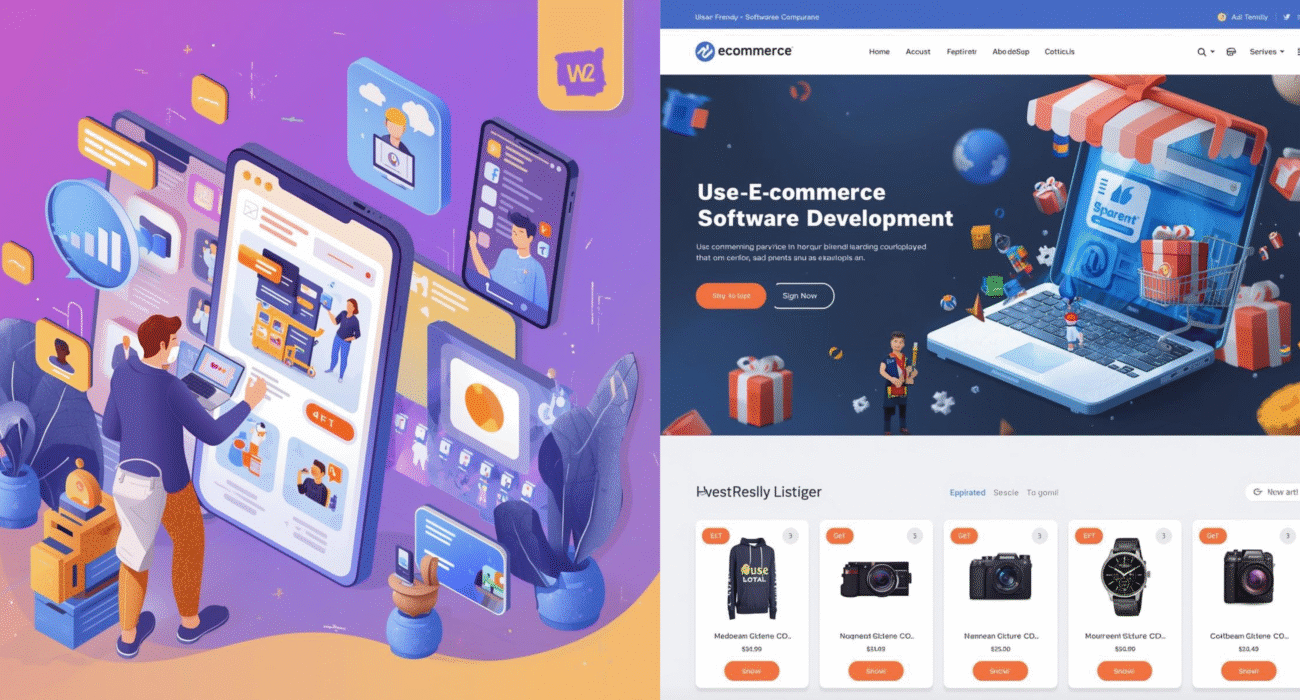
E Commerce Software Development Made Simple: From Idea to Online Store
It seems hard to start an online store because there are so many technical terms like APIs, backend systems, and payment gateways. But what if starting your dream online store didn’t have to be so hard?
You have a great business idea, but you don’t know how to make it work. Words like “e commerce software development” can be scary. You don’t know where to begin or who to trust to help you make your vision a reality.
Here’s the truth: e commerce software development is much simpler than it appears. This guide breaks down the entire journey from initial concept to successful launch in plain language anyone can understand. Whether you’re starting fresh or upgrading an existing store, understanding e commerce software development helps you make smarter decisions and avoid costly mistakes.
What is E Commerce Software Development?
Simple Definition and What It Does
E commerce software development is the process of creating the digital systems that power online stores. Think of it as building a sophisticated retail space in the digital world, complete with product displays, cash registers, inventory management, and customer service, all working smoothly together.
At its core, it creates everything your customers see and interact with: browsing products, adding items to their cart, completing secure checkout, and tracking orders. Behind the scenes, it builds the systems you use to manage inventory, process orders, handle shipping, and analyze sales data.
The software handles complex technical work automatically. When a customer buys a product, the system updates inventory, processes payment, generates shipping labels, sends confirmation emails, and records the transaction, all in seconds.
Why Your Business Needs It
Physical stores have natural limitations. You’re restricted by location, operating hours, and the number of customers who can shop at once. E commerce software development services eliminate these barriers completely.
Your online store operates 24/7 and can reach customers all over the world. A well-designed system can handle hundreds of shoppers at once without any problems. Digital marketing is better at reaching specific groups of people, which means that customer acquisition costs are much lower than in traditional retail.
The data insights alone justify the investment. Your software tracks which products customers view most, where they abandon carts, what marketing drives sales, and countless other metrics. Most importantly, e-commerce software development company solutions scale with your growth, start with ten products and expand to thousands using the same foundation.
Types of E Commerce Software Solutions
Ready-Made Platforms vs Custom Development
The e-commerce world offers two main paths: ready-made platforms and custom development.
Ready-made platforms like Shopify, WooCommerce, and BigCommerce provide complete solutions out of the box. You sign up, choose a template, add products, and start selling within days or weeks. Monthly costs typically range from $29 to $299 depending on features needed.
The trade-off? Limited customization. You work within the platform’s rules and capabilities. Design options, while numerous, still make your store look similar to thousands of others.
When it comes to custom e-commerce software development, the opposite is true. Developers make everything just for your business needs. Every part of the design, every feature, and every workflow is made to fit your needs perfectly. You own the code completely and there are no platform restrictions.
Custom solutions cost more up front, usually starting at $25,000 and going up from there depending on how complicated they are. Instead of weeks, development takes three to six months. But with templates, you can’t get full control, unlimited scalability, or unique competitive advantages.
Which One is Right for You?
Choose ready-made platforms if you’re testing a business idea, selling fewer than 100 simple products, operating with budgets under $15,000, or needing to launch within 4-6 weeks.
You should think about custom e-commerce software development if you have unique business rules that standard platforms can’t handle, need specific integrations with existing systems, want to gain a competitive edge through proprietary features, plan to grow your business beyond the limits of the platform, or need full ownership of your technology.
Most businesses starting out benefit from platforms. Once you’re generating consistent revenue and hitting platform limitations, custom development makes financial sense.
The Development Process: Step by Step
Phase 1: Planning and Design (Weeks 1-4)
The foundation of successful e commerce software solutions development starts with thorough planning. This phase determines everything that follows.
Planning begins with defining your requirements clearly: What products will you sell? Who are your target customers? What features are essential versus nice-to-have? What’s your realistic budget and timeline?
The design phase focuses on user experience. Designers create mockups showing exactly how your store will look and function. Key design elements include easy navigation, high-quality product images with zoom capabilities, clear calls-to-action, trust signals like reviews, and mobile optimization since most shopping happens on phones.
Smart retail and e-commerce software development companies involve you heavily during this phase. You’ll review wireframes, provide feedback, and approve the overall direction before development begins.
Phase 2: Development and Integration (Weeks 5-10)
This phase is where your vision becomes functional reality. E commerce software developers split their work into frontend (what customers see) and backend (systems managing everything behind the scenes).
Frontend development turns approved designs into working code. This includes product catalog pages with filtering, shopping cart functionality, user account features, search functionality, and checkout forms that are easy to fill out quickly.
Backend development creates the powerful engine invisible to customers: database systems storing product information, inventory management tracking stock levels, order processing workflows, admin dashboards, and customer management systems.
Integration work connects your store to essential external services like payment gateways (Stripe, PayPal), shipping providers (FedEx, UPS), email marketing platforms (Mailchimp), and analytics tools.
Phase 3: Testing and Launch (Weeks 11-13)
Testing separates projects from professional e commerce software development services. This phase catches bugs before customers encounter them.
Comprehensive testing includes functionality testing (checking that every button and link works), performance testing (making sure pages load quickly), security testing (making sure there are no security holes), cross-browser testing, and mobile testing. Load testing makes sure that servers can handle traffic spikes by simulating hundreds of users at once.
Launch follows careful steps: soft launch to a limited audience first, monitoring closely for issues, then proceeding to full public launch. Post-launch, developers monitor intensively for the first week, addressing any unexpected issues quickly.
Essential Features Your Store Must Have
Every successful online store need core feature that customers expect and your business requires.
Product management capabilities:
- Add and edit products easily without technical help
- Support for multiple high-quality images per product
- Inventory tracking that updates automatically
- Logical categories and detailed descriptions
Shopping experience features:
- Powerful search functionality
- Filtering options by price, size, color, and attributes
- Wishlist functionality for saving items
- Related product suggestions
The checkout process:
- Guest checkout options
- Multiple payment methods including credit cards and digital wallets
- Auto-fill forms for faster completion
- Clear shipping cost calculations
- Immediate order confirmation emails
Security features:
- SSL certificates creating the security padlock
- PCI-compliant payment processing
- Customer data encryption
- Fraud prevention systems
Mobile optimization:
- Perfect functionality on smartphones
- Fast loading on mobile data connections
- Easy thumb navigation
- Support for Apple Pay and Google Pay
Understanding Costs and Timelines
E commerce software development agency pricing varies significantly based on scope and approach.
Small stores typically invest $5,000-$15,000 using platform-based approaches with some customization. Development takes 1-2 months. This works well for under 100 products with standard features.
Medium-sized stores run $15,000-$50,000 with semi-custom development, taking 2-4 months. This range suits 100-1,000 products with multiple integrations and some unique features.
Large stores and enterprise solutions require $50,000-$200,000+ for fully custom retail and e-commerce software development, taking 4-8 months. This investment makes sense for 1,000+ products with complex features and high transaction volumes.
Costs depend on a number of things, such as the number and complexity of custom features, the complexity of the design, third-party integrations, and the location of the development team.
Ongoing costs include hosting ($100-$500 monthly), maintenance and updates ($500-$2,000 monthly), security monitoring, and payment processing fees (typically 2.9% plus 30 cents per transaction).
A well-built store generates revenue far exceeding development costs within the first year when marketed effectively.
Choosing the Right Development Team
Selecting your development partner ranks among your most important decisions. The right team brings your vision to life smoothly.
Essential qualities to seek include proven e-commerce experience (they should have built multiple online stores), professional portfolios, and excellent communication skills. Quality e commerce software development companies outline clear development steps, provide realistic timelines, and give honest assessments of what’s possible within your budget.
Important questions to ask: How many online stores have you built? Can we see examples and talk to those clients? What’s your typical development process? Who owns the code after completion? What’s included in post-launch support?
Red flags to avoid include unrealistic timeline promises, refusal to share portfolios, vague or constantly changing pricing, poor communication from the start, and lack of post-launch support plans.
Expect to pay more for quality. The cheapest bid often becomes the most expensive when accounting for delays, poor quality, and eventual rebuilds.
Conclusion: Your Next Steps
Building an online store doesn’t have to overwhelm you. E commerce software development becomes straightforward when you understand the process and partner with experienced professionals who communicate clearly.
Start by defining your requirements honestly. What do you really need now versus what you might want eventually? Choose the development approach matching your current budget and timeline while allowing room for future growth. Focus on essential features first, you can always add advanced capabilities after launch based on real customer feedback.
How Softaims.ai Can Help
At Softaims.ai, we specialize in e commerce software development for businesses throughout the USA. Our team simplifies technical complexity and guides you from initial concept to successful online store generating real revenue.
We offer complete e-commerce software development services including strategic planning, custom design optimized for your customers, secure development using modern technologies, thorough testing across all devices, and ongoing support keeping your store running perfectly.
Whether you need a straightforward store to start selling quickly or a complex custom solution with unique features, we create systems tailored to your specific business goals and budget.
Contact us today for a free consultation. We’ll discuss your vision, explain the process clearly without confusing jargon, and provide transparent pricing with no surprises.
Frequently Asked Questions
Q.What exactly is e commerce software development?
E commerce software development is creating the complete digital system that runs an online store, including the customer-facing website, backend systems for inventory and orders, payment processing, and all administrative tools. It’s essentially building both the retail space and operations center for a digital business.
Q.How long does it take to build an online store from scratch?
It takes 3 to 6 weeks to build a simple store using platform templates. It takes 3 to 6 months to build a custom store with special features, including all phases. Enterprise solutions can take anywhere from six to twelve months, depending on how complicated they are.
Q.Should I use a platform like Shopify or build custom software?
Platforms are great for getting started, testing ideas, or launching quickly with simple requirements. When you have special business needs, need certain integrations, or plan to grow a lot beyond what the platform can handle, choose custom e-commerce software development.
Q.What does custom e commerce software development actually cost?
Most small to medium-sized businesses spend between $25,000 and $75,000, but the cost of custom features can be as low as $15,000 or as high as $200,000 or more. Some of the things that affect this are how complicated the features are, what the design needs are, what integrations are needed, and how much the team charges.
Q.Do I need technical knowledge to run my online store after it’s built?
No coding knowledge needed for day-to-day operations, quality e commerce applications software development includes user-friendly dashboards for managing products, orders, and customers. However, you’ll need developer support for major updates or new features.