

From Data to Decisions: How Generative AI in Supply Chains Works
Researchers at MIT discovered something amazing: Generative AI in supply chains can now handle shipping and inventory automatically, cutting the time it takes to make decisions from days to minutes. Most supply chains collect tons of data but struggle to make quick decisions because analyzing everything manually takes too long.
This guide shows how generative AI in supply chains turns all that raw data into smart, fast decisions. If you’re curious about using this technology or looking for practical tips on leveraging generative AI, understanding generative AI in supply chains helps you make choices that actually improve your business.
Understanding Generative AI in Supply Chains
What Makes Generative AI Different
Generative AI in supply chains doesn’t just look at your data and tell you what happened; it also comes up with new ideas and ways to solve problems. Regular analytics might show you last month’s sales numbers. Generative AI takes that information and automatically suggests what you should do next, writes reports for you, and even drafts emails to suppliers.
Different types of generative AI in supply chains help in various ways. Some read and write like humans, helping with documents and communications. Others work with images for warehouse layouts. Some find hidden patterns in complex data, and others create fake data for testing new systems safely.
Here’s how it works in simple terms: the system reads through all your past data and current information, learns what patterns usually lead to good outcomes, creates several different “what if” scenarios showing possible futures, picks the best option and tells you why, and explains everything in normal language anyone can understand.
Generative AI vs Predictive AI in Supply Chain Context
Let’s clear up the difference between generative AI vs predictive AI because they work together but do different things. Predictive AI looks at your past sales and says “based on history, you’ll probably sell 1,000 units next month.” It answers “what will happen?”
Generative AI goes further. It takes that prediction and says “okay, if you’ll sell 1,000 units, here’s exactly what you should order from which suppliers, when to order it, and here’s a draft email to send them.” It answers “what should we do?” and actually helps you do it.
The smart move? Use both together. You don’t have to choose between generative AI vs predictive AI. Let predictive AI figure out your demand and generative AI write your supplier communications automatically.
Main Goal of Generative AI in Supply Chain Management
The main goal of generative AI in supply chains is simple: turn mountains of data into faster, better decisions without making your team work harder on boring, repetitive analysis. This changes everything about how supply chains work.
Making insights automatic means no more waiting days for someone to analyze data and explain what it means. Supply chain managers can just ask questions like they’re texting a colleague and get answers immediately with suggestions on what to do.
Running things on autopilot is now possible. Think about Walmart’s inventory system that notices when one store has too much of something while another store is running low. It sends products between stores on its own to fix the problem, so no people are needed. This is what business transformation in generative AI looks like in real life.
Anyone can use the data without being a tech expert. Your warehouse manager can ask the system “why are we short on product X?” and get a clear answer without calling the IT department or data team.
Staying ready for problems happens automatically too. The system watches news, weather, and world events constantly, spots potential issues with suppliers before they happen, figures out backup plans, and has everything ready just in case.
Key Generative AI Use Cases Transforming Supply Chains
Demand Forecasting and Planning
Generative AI in supply chains use cases in forecasting look at your past sales, seasonal patterns like holiday shopping, promotional calendars, what’s happening in the economy, and general market trends to predict what you’ll sell.
What makes this special? Instead of just one forecast number, generative AI creates several possible scenarios. A biotech company now asks their AI system questions in plain English about future demand and gets instant analysis that used to take their team days to prepare.
Real benefits include:
- Fewer situations where you have too much or too little stock
- Products moving through your warehouse faster
- Production schedules that actually match what you’ll sell
- Better use of warehouse space
- Supply matching actual customer demand more closely
Risk Management and Supplier Intelligence
Every day, generative AI in supply chains reads thousands of news articles to find out about anything that might affect your suppliers, such as natural disasters, political issues, money problems, strikes by workers, or new rules. Microsoft’s system does this automatically and tells supply chain managers when something important happens.
The system gives each supplier a risk score and suggests who else you could buy from if problems arise. Unilever uses this to watch for anything that might disrupt their suppliers. Their AI warns them about issues and suggests alternatives before production gets affected.
Contract help is another big benefit. The AI reads through supplier contracts, picks out the most important parts, summarizes key terms in plain language, finds possible problems or obligations you should know about, compares terms across different contracts, and suggests better ways to negotiate. All of this used to take lawyers hours.
Inventory Optimization
Walmart’s self-healing inventory shows what enterprise use cases for generative AI in supply chains can do. Their system automatically moves products to where they’re needed when stores have too much or too little of something, and it fixes problems before customers notice. All of this happens in the background without any human involvement.
Route planning gets smarter too. The AI checks traffic, gas prices, delivery dates, and weather forecasts, and then it chooses the best routes based on what matters most to you, if that’s saving money, getting there faster, or something else. It adjusts constantly as conditions change.
Generative AI Benefits Driving Business Transformation
Speed and Efficiency Gains
Generative AI in supply chains benefits include cutting decision time from days to just minutes. Managers don’t wait for data experts to run reports or explain complicated results anymore. Anyone can ask the system questions and get answers they can actually use right away.
What gets done automatically:
- Finding and pulling together data from everywhere
- Spotting important patterns and trends
- Running “what if” scenarios to test ideas
- Creating reports and sending them to the right people
- Alerting you when something unusual happens
Companies report getting 40-60% more planning work done in the same time. Some specific tasks, like preparing data for analysis, happen 90% faster when generative AI engineers set things up properly.
Cost Reduction at Scale
McKinsey research estimates generative AI in supply chains could cut supply chain costs by up to $500 billion across all industries. This happens through more accurate demand forecasts reducing wasted inventory, smarter routes cutting transportation costs, maintenance happening before equipment breaks, and automated processes reducing labor needs.
Real companies are already seeing savings like contract reviews taking minutes instead of hours, fewer expensive rush shipments from better planning, lower storage costs from optimized inventory levels, and reduced costs from maintaining better supplier relationships.
Enhanced Decision-Making Capabilities
Generative AI helps you make better choices by suggesting the best next action, explaining why in plain English, showing patterns you might have missed, and comparing trade-offs between options like cost versus speed versus quality.
Everyone gets access to insights now. Executives and planners don’t need technical teams translating data for them. They ask questions conversationally and get actionable answers instantly, letting them respond faster when markets change.
Implementing Generative AI: From Integration to Application
Generative AI Integration Challenges
Generative AI integration means connecting the AI to your existing systems like inventory software, warehouse management, and shipping platforms while making sure your data is clean and consistent. Technical challenges include connecting different systems together, handling data in various formats, keeping everything synchronized in real-time, and having enough computer power for AI.
People challenges are often harder than technical ones. Teams need time adjusting to new ways of working, training on how to work alongside AI, clear rules about when to trust AI suggestions, and confidence that AI recommendations actually help.
A generative AI development company speeds this up by providing proven methods that work, ready-made connections for common software, help managing the changes, and training designed specifically for supply chain teams.
Generative AI App Development for Supply Chains
Generative AI app development for supply chains focuses on interfaces anyone can use without training, letting people ask questions in normal conversation, processing information instantly, showing AI insights visually, and working on phones for people in warehouses or on the road.
Important features include:
- Chat-style interfaces for asking questions
- Automatic alerts sent to the right people
- Scenario tools where you adjust assumptions and see results
- Working alongside your existing dashboards
- Records showing why AI suggested each decision
When you hire generative AI developers, look for people who understand both the technology and how supply chains actually work. Developers need more than just technical skills; they also need to know how supply chain professionals think and what they need.
Generative AI for Data Management
Generative AI for data management helps organize data automatically, spots quality problems, creates fake data for testing new systems, writes documentation explaining your data, and maps how different data sources connect.
Quality improvements happen through finding weird data that doesn’t make sense, suggesting fixes for inconsistent records, filling gaps where data is missing, and standardizing formats across all your systems. Clean data is critical because AI is only as good as the information it learns from.
Generative AI experts recommend checking your data quality first before implementing advanced features. Fix the foundation of your data first if it’s messy. You might even use generative AI to speed up the process.
Generative AI Security Risks and Mitigation Strategies
Important security concerns to think about:
Privacy risks include sensitive business data being sent to outside AI services, potentially exposing proprietary information, and following regulations like GDPR and CCPA that protect customer information.
AI security threats involve hackers manipulating AI outputs, corrupting the data AI learns from, and tricking the system through carefully crafted questions that extract sensitive information.
Operational risks come from trusting AI too much without human checking, making decisions based on bad or biased data, and system failures disrupting critical operations during busy periods.
How to stay safe:
- Keep AI systems on your own servers or private cloud
- Use strong security controls and encryption
- Have humans check critical decisions
- Regular security testing by experts
- Clear rules about AI use
- Train teams about generative AI security risks
When you hire generative AI engineers, make sure they know security alongside technical skills. Security can’t be added as an afterthought when dealing with competitive business information.
Enterprise Use Cases: Real-World Examples
Real companies showing proven results:
Microsoft Dynamics 365 Copilot reads supplier news automatically, creates risk assessments, writes targeted communications, and represents the first major implementation in actual supply chain operations.
OMP supply chain planning uses generative AI for automatic demand sensing, creating scenarios for disruptions, and optimizing across multiple goals simultaneously.
Walmart’s self-healing inventory finds problems on its own, moves products without help, and keeps everything running during outages, handling millions of transactions every day without any help.
Unilever’s risk watching tracks political, environmental, and economic events, scores supplier risks, and suggests alternative suppliers before disruptions affect production.
These enterprise use cases for generative AI prove the ROI through lower costs, faster decisions, and better resilience. Companies report getting their money back within 12-18 months.
The Future of Generative AI Workflows in Supply Chains
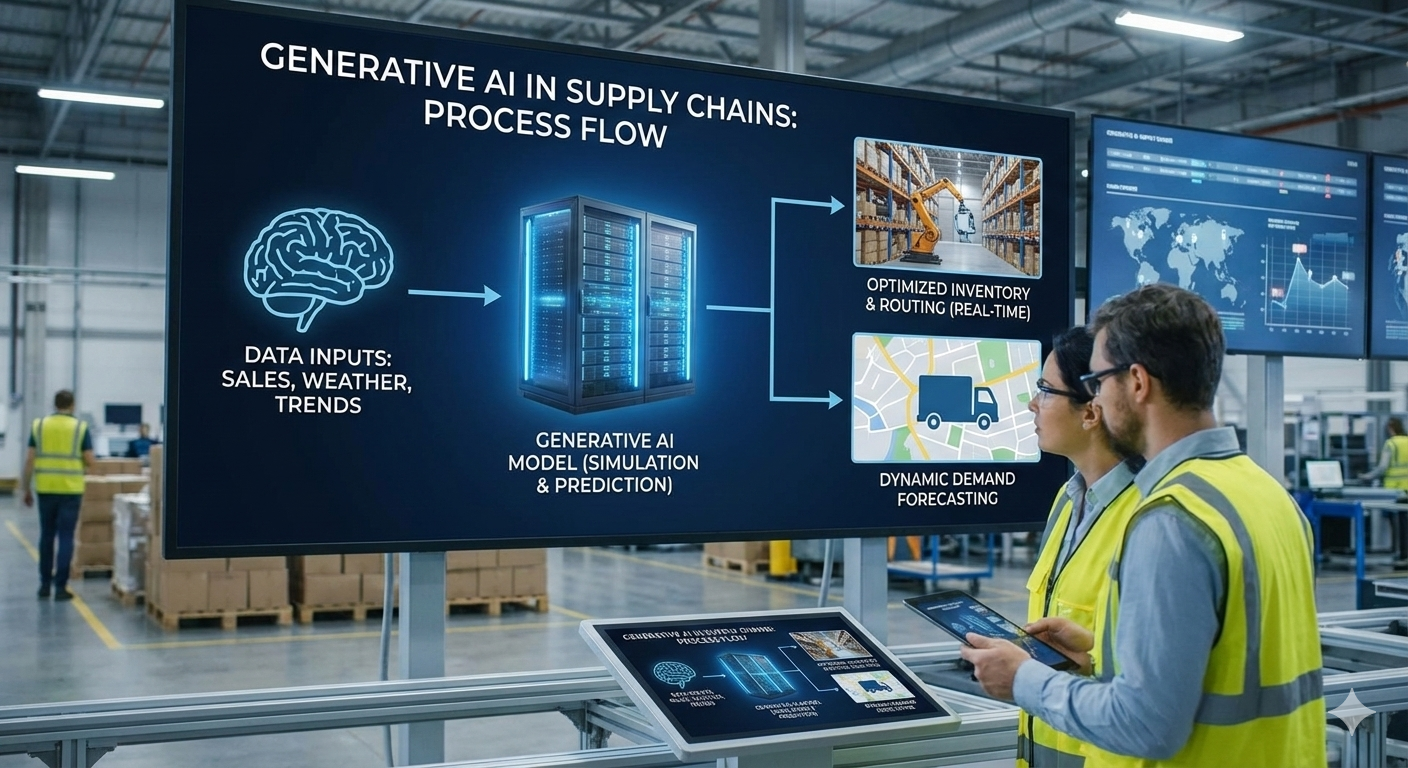
Generative AI workflows are moving from helper tools to systems that run themselves. The progression goes from generating insights to making recommendations to making decisions and taking actions automatically.
Companies starting now get ahead of competitors. The technology works. It’s proven beyond the hype and delivers real results through faster decisions, lower costs, and better handling of disruptions.
Success needs smart implementation, proper rules, and helping people adapt to new ways of working. Practical tips on leveraging generative AI include starting with high-impact areas first, ensuring your data is clean, keeping humans checking things initially, and expanding based on what actually works.
How Softaims.ai Can Help
At Softaims.ai, we specialize in application development with generative AI in supply chain operations. Our team of generative AI experts understands both the technology challenges and how supply chains really work, building solutions that perform in actual business environments.
We provide generative AI app development services including custom supply chain AI assistants, risk monitoring systems, demand forecasting tools, and inventory optimization platforms. Our expertise covers generative AI for data management, making sure you have clean, accessible data powering accurate insights.
As a leading generative AI development company, we help with business transformation in generative AI through strategy advice, proof-of-concept projects, full implementation, and team training. When you hire generative AI developers through Softaims.ai, you get professionals combining AI knowledge with real supply chain experience.
Contact Softaims.ai today to explore how generative AI in supply chains can transform your operations from reactive firefighting to proactive planning, from drowning in data to making confident decisions. Our generative AI engineers will look at your needs and suggest the best approach for your situation.
Frequently Asked Questions
Q.What is the main goal of generative AI in supply chains?
The main goal of generative AI is turning huge amounts of supply chain data into faster, smarter decisions while automating boring repetitive work. It lets systems spot problems, figure out solutions, and take action automatically without waiting for people.
Q.Can I generate code using generative AI models for supply chain systems?
Yes, generative AI is great at writing code for supply chain applications including scripts that transform data, connections between systems, dashboard queries, and automation workflows. Companies report 90% faster coding for data tasks using AI help.
Q.How can generative AI be used responsibly as a tool in supply chains?
Use generative AI responsibly by having humans check important decisions, making sure AI suggestions make business sense, setting clear rules about AI use, keeping data private and secure, and training teams on what AI can and can’t do reliably.
Q.What is a key feature of generative AI that benefits supply chains?
A key feature is talking to it in normal English, letting anyone ask questions without technical training. Supply chain workers ask questions like texting a colleague and get useful answers instantly, making analytics available to everyone.
Q.What is the difference between agentic AI and generative AI in supply chain context?
Generative AI creates things like forecasts, scenarios, and recommendations based on your data. Agentic AI goes a step further by making decisions about inventory, placing orders, and changing plans on its own without asking for permission first.