
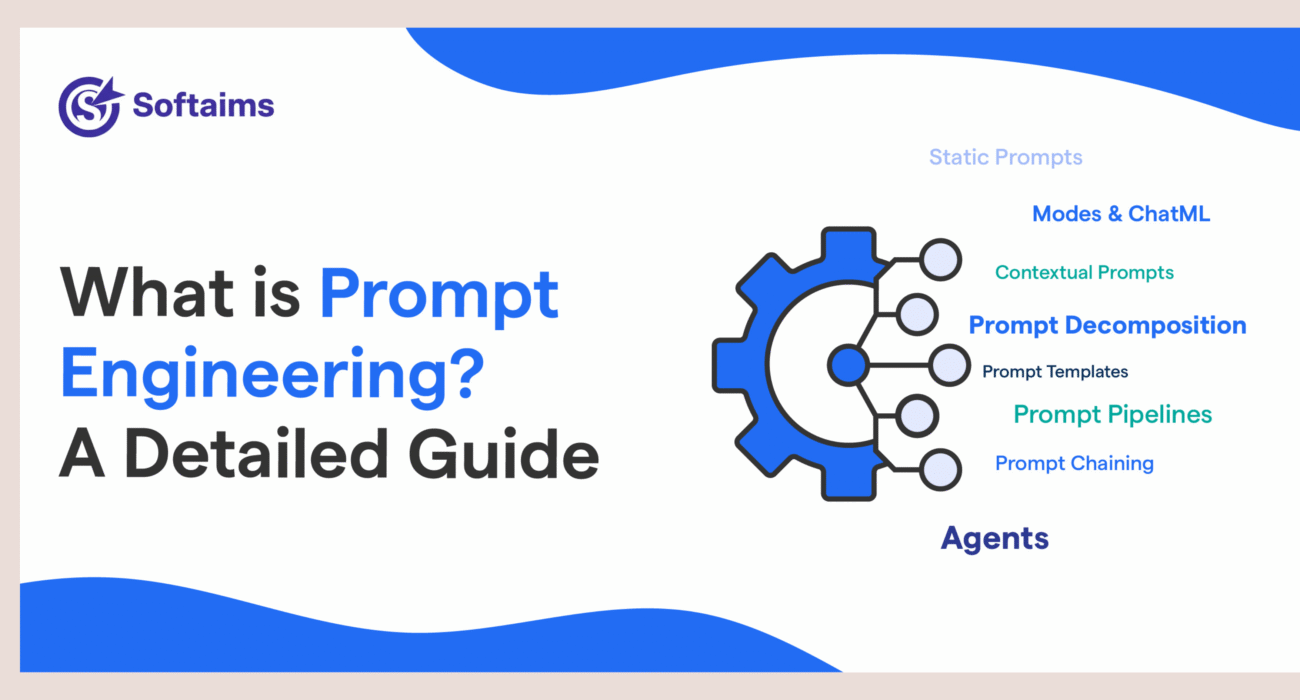
Understanding Prompt Engineering: The Skill That Makes AI Actually Useful
A single word changed ChatGPT’s accuracy from 20% to 95% in a medical coding task. That word? “Think step-by-step.”
You’re probably using ChatGPT but getting vague, unhelpful answers. Your team wastes hours tweaking prompts with no clear strategy. Prompt engineering transforms how you communicate with AI. This guide reveals what it is, why it matters, and how to master it, even without a tech background.
At Softaims, our AI prompt engineers build production-ready AI systems that deliver consistent, accurate results for businesses nationwide.
What is Prompt Engineering? The Simple Truth
Prompt engineering is crafting instructions that make AI models give you exactly what you need. It’s the art of “talking to AI” effectively. Think of it like knowing the right questions to ask a highly knowledgeable but literal assistant.
AI models are powerful but don’t read your mind. Compare these two prompts: “Write about dogs” versus “Write a 200-word blog intro about golden retrievers for dog owners, focusing on temperament and family-friendliness.” The first gets you generic content. The second delivers exactly what you need.
Bad prompting is like searching Google for “food”, you get millions of useless results. Good prompting is like searching “best Mexican restaurants in Austin under $30”, you get exactly what you need. Specificity wins.
Prompt engineers design instructions that consistently produce quality outputs. They test and refine prompts through systematic experimentation and build prompt systems for products used by thousands. This isn’t just chatting with ChatGPT, it’s engineering production solutions.
The Surprising Truth About Prompt Engineering Today
The industry has shifted dramatically. In early 2023, companies posted job listings for “prompt engineers” offering $375,000 salaries. Today, AI models got smarter at understanding intent, changing everything.
Conversational Prompting is what everyone needs for personal ChatGPT use and basic productivity. Everyone should learn this foundational skill.
Product-Level Prompting is the high-value skill involving prompts running millions of times in production AI systems and enterprise applications. This is where real opportunities exist. Our AI Chatbot Development Company builds these scaled systems for businesses across the USA.
Basic prompting is now essential for all jobs, like knowing Excel. Advanced prompt engineering remains critical for AI product development. Companies need prompt engineers who understand system design, not just casual ChatGPT users. It’s not obsolete, it evolved.
Core Principles: What Makes Prompts Work
Clarity Beats Cleverness
Compare “Tell me about that space thing from the 60s” with “Explain the Apollo 11 moon landing in 3 paragraphs for high school students.” Clear instructions produce predictable results while clever wordplay confuses AI.
Context is King
Give AI the background it needs. Transform your prompt from “Write a product description” to “Write a 100-word product description for noise-canceling headphones targeting remote workers who struggle with home office distractions. Emphasize productivity benefits and comfort for all-day wear.”
The second prompt includes who it’s for, what to emphasize, and how long it should be, that’s the power of context.
Show, Don’t Just Tell
Few-shot prompting is one of the most powerful techniques available. Providing examples of desired output can improve accuracy from 0% to 90%. Research shows medical coding went from total failure to near-perfect results by adding just three examples.
Here’s how it works:
Task: Categorize customer feedback as Positive, Negative, or Neutral
Examples:
- “Great product, fast shipping!” > Positive
- “Item broke after 2 days” > Negative
- “Delivered on time” > Neutral
The AI now understands exactly what you want and how to format responses.
Structure and Constraints
Well-structured prompts work better than long rambling instructions. Use bullet points for clarity, number your steps, and add headers to organize complex requests. Setting clear boundaries like word count, format, and style actually improves results by focusing the AI’s attention on what matters.
“Write exactly 3 benefits in 50 words each” produces better results than “Write some benefits.”
Advanced Techniques That Actually Work
Chain-of-Thought Prompting
Ask AI to “think step-by-step” and watch accuracy improve by 40% or more. This forces logical reasoning instead of pattern matching. Try: “Calculate 15% tip on $47.83. Show your work step-by-step.” The AI will break down the calculation and arrive at the correct answer more reliably.
Role Assignment Strategy
Here’s what most people get wrong: saying “You are an expert” doesn’t improve factual accuracy. Role prompts help with tone and style, not correctness. “You are a patient teacher explaining to a 10-year-old” changes tone effectively, but “You are a math expert” doesn’t make calculations more accurate.
Decomposition for Complex Tasks
Breaking big requests into smaller steps produces significantly better results:
- “List 10 blog topic ideas about AI”
- “Expand idea number 3 into an outline”
- “Write introduction based on this outline”
Each step produces better results than asking for everything at once.
Temperature Control
Temperature controls randomness in AI responses. Lower temperature (around 0.2) produces consistent, factual responses. Higher temperature (around 0.8) generates creative, varied outputs. Match temperature to your task, use low for facts, high for creativity.
Practical Applications: Where Prompt Engineering Shines
Customer Support Automation
Build chatbots that handle 70% of support tickets by creating context-aware responses and automatically escalating complex issues. Mid-size companies save over $200,000 annually with properly designed AI support systems. Our AI agent development services help businesses implement these solutions.
Content Creation at Scale
Generate marketing copy that matches brand voice while maintaining consistent style across hundreds of pieces. Create blog posts, social media content calendars, and SEO-optimized writing with detailed prompts that ensure brand consistency.
Code Generation and Development
Translate requirements into working code, debug existing code, and generate documentation automatically. These tools integrate with development environments like Cursor AI to accelerate development. Our Full-Stack AI Engineers combine prompt engineering with traditional development skills.
Data Analysis and Business Automation
Ask questions in plain English like “Show me top 10 customers by revenue last quarter” to generate insights from complex datasets. Automate email responses, generate reports, and create meeting summaries. For private deployments, our Ollama deployment specialist services keep AI completely within your infrastructure.
Healthcare Applications
Analyze patient data with proper security measures, search medical literature efficiently, and generate clinical summaries. This requires expert prompt design and domain knowledge. Our Healthcare AI Consultant services specialize in HIPAA-compliant medical AI systems.
The Prompt Engineering Toolkit
Every effective prompt should include these essential elements:
Clear Task Definition: Specify exactly what you want with actionable requests.
Context and Constraints: Provide background information along with output format requirements and length specifications.
Audience Specification: Define who this is for and their knowledge level.
Examples When Appropriate: Show desired output format through 1-3 clear examples.
Output Structure: Specify whether you need bullet points, paragraphs, tables, or specific formatting.
Common Mistakes to Avoid
Don’t write vague prompts like “Write something good about AI.” Instead, try “Write 3 business benefits of AI chatbots for e-commerce companies in 150 words.” Avoid creating 500-word prompts with 20 different requirements, focus on 3-5 key points.
Always specify output format rather than just asking for information. Test different phrasings because your first prompt is rarely perfect. Provide business context since AI doesn’t automatically know your situation. Set clear constraints to ensure consistent outputs.
Getting Started: Your Action Plan
For Beginners
Start with basic experimentation using ChatGPT or Claude for simple tasks. Try different phrasings for the same request and notice what changes results. Spending 30 minutes daily practicing will show dramatic improvements within a week.
Learn core techniques by practicing few-shot prompting with examples, adding context to your prompts, and specifying output formats clearly. Build complexity gradually by chaining multiple prompts together and testing different temperature settings.
For Professionals
Document your best-performing prompts and create reusable templates for common tasks. Test prompts systematically with consistent evaluation criteria and measure output quality objectively.
Study production prompt systems used by major companies and learn RAG and context engineering for enterprise applications. For complex systems, consider working with our dedicated LangChain developers who specialize in production AI. Our Enterprise RAG solutions help businesses access scaled knowledge effectively.
The Future of Prompt Engineering
AI models continue becoming more sophisticated with better understanding of intent, reduced sensitivity to exact wording, and expanded context windows. Multimodal capabilities now process text, images, and code simultaneously.
Automated optimization tools are emerging as AI improves prompts automatically. Companies implement A/B testing at scale while prompt versioning systems track what works. Integration is happening everywhere as every software tool adds AI capabilities.
Security concerns grow more important as teams must protect against prompt injection attacks. Ensuring AI safety and alignment becomes critical while ethical considerations in prompt design matter more than ever.
The bottom line? Basic prompting is now an essential skill for everyone. Advanced prompt engineering remains a high-value specialization. This field isn’t disappearing; it’s evolving and maturing as companies still need experts for production systems.
Master Prompt Engineering Today
Prompt engineering isn’t magic; it’s a learnable skill that dramatically improves your AI results. Whether you’re using ChatGPT for personal tasks or building enterprise AI systems, understanding how to communicate effectively with AI gives you a competitive advantage.
The fundamentals are straightforward: make your instructions specific, provide background context so AI understands your needs, use examples because few-shot prompting dramatically improves accuracy, iterate systematically, and apply clear constraints to produce focused outputs.
The future belongs to those who can leverage AI effectively and that starts with prompt engineering.
Ready to Build Production AI Systems?
Softaims helps businesses harness AI through expert prompt engineering and development services.
Our AI Development Services:
Custom AI chatbot development with optimized prompts, LangChain application development for complex workflows, Enterprise RAG solutions for knowledge management at scale, and AI agent development for business process automation.
Specialized Expertise:
Healthcare AI consulting with HIPAA-compliant systems, Full-Stack AI Engineers for end-to-end solutions, Ollama deployment for private secure AI infrastructure, and vector database integration for semantic search capabilities.
Supporting Infrastructure:
Next.js developers for AI-powered web applications, React Native developers for mobile AI solutions, Node.js developers for scalable API backends, and TypeScript developers for type-safe AI systems.
Contact Softaims today for a free consultation. Let our expert AI prompt engineers and developers transform your vision into production-ready AI solutions that deliver real business value.
Ready to transform your business with AI? Connect with expert prompt engineers at Softaims today.
Frequently Asked Questions
Q.What is prompt engineering in AI?
Prompt engineering in AI is the process of creating and improving prompts, which are instructions that tell AI models like ChatGPT, Claude, or Gemini what to do in order to get specific, high-quality answers. To get useful results instead of vague or wrong answers, you need to know how to talk to AI in a clear way, give it context, and structure your requests correctly.
Q.What does a prompt engineer do?
A prompt engineer designs, tests, and improves the instructions that AI systems used in products and services. They build prompt systems that run millions of times in production applications like chatbots, content generators, or automated support systems. At Softaims, our AI prompt engineers build enterprise-grade AI solutions that deliver consistent, accurate results at scale.
Q.Why is prompt engineering important?
Prompt engineering makes sure that AI models give back results that are correct and useful. It’s the skill of writing good prompts that control the model’s behavior and make sure that people and AI can talk to each other effectively.